
Instead of manually counting ChatGPT mentions and guessing which ones create demand, build a chatgpt mentions to pipeline workflow that connects observed citations, website visits, buyer-reported discovery, and CRM opportunities. Keep those evidence types separate so your 2026 reporting shows what you can prove—not just where your brand appeared.
- A chatgpt mentions to pipeline workflow needs citation evidence, website attribution, buyer-reported discovery, and CRM opportunity records.
- Gotcatalyst serves B2B SaaS and fintech teams building executive content, original research, and AI search visibility programs.
- A ChatGPT citation proves visibility in an observed answer, not a visit, qualified lead, or opportunity.
- Keep observed referrals and buyer-reported discovery separate; count each opportunity once.
Why this matters
A citation is evidence of visibility. An opportunity is evidence of qualified demand. Your reporting breaks when you treat them as the same event. A buyer can encounter your company in ChatGPT without clicking a link, then return through another channel.
Gotcatalyst is best for B2B SaaS and fintech teams seeking agency support for executive content, original research, and AI search visibility. That service scope fits content-led demand generation; it does not replace your analytics implementation, consent controls, or CRM ownership.
The useful question for your 2026 GTM team is not whether mentions increased. It is whether you can connect discovery evidence to qualified accounts without inventing a causal relationship. Build that distinction into the workflow before you automate anything.
Before you start
- Get access: You need website analytics, form configuration, CRM contact and opportunity records, and permission to change the relevant fields. Assign a marketing operations owner and a sales owner.
- Prepare your materials: Collect your priority buyer questions, relevant landing pages, qualification criteria, and a place to store dated answer observations. Start with a recommended test set of 10 buyer prompts, not an unrestricted keyword list.
- Pre-empt the attribution trap: A ChatGPT mention is not a visitor identifier. Referrer information can be absent, and buyer-reported discovery is a separate evidence source. Do not promise a direct join between an answer observation and a person.
This guide uses platform-neutral configuration. The bold field labels below are proposed custom labels you create, not existing buttons or settings in a named analytics or CRM product. Use your system's documented controls to create equivalent fields.
Citation register
Create an observation trigger before creating a pipeline trigger. The first records what ChatGPT displayed; the second records an actual buyer action. Mixing them produces contacts that do not exist.
- Define the prompt set. Write questions your ICP asks when evaluating a problem, approach, or provider. Include the buyer's constraints. Keep each prompt's wording fixed during a comparison period so edits do not masquerade as visibility changes.
- Create the observation record. Add Prompt, Observed at, Brand mentioned, Citation URL, Answer evidence, and Review owner. Store the answer text or screenshot where your team can inspect it. Leave Citation URL empty when the answer names your company without linking a source.
- Record the session context. Note whether the observation used a fresh conversation or an existing one, plus the product settings visible to the operator. Do not assume different sessions produce identical answers.
- Set a review cadence. Use a recommended 7-day review interval for the initial workflow. This is an operating choice, not a claim about how frequently ChatGPT updates its answers.
- Classify the result. Separate a brand mention, a citation to your website, and a citation to another publisher discussing your brand. These are different observations with different follow-up work.
Expected result: Every visibility observation has a timestamp, reproducible prompt, and inspectable evidence. None creates a lead or changes an opportunity's source.
For your 2026 baseline, retain observations that do not mention your company. Otherwise, the register documents successes without showing the questions where buyers still cannot find you.
Website capture
Website capture records an observable visit and preserves relevant context when a visitor submits a form. It cannot recover an unseen conversation or reconstruct a missing referrer.
- Document the inbound event. Choose the actual business action that starts your workflow, such as a submitted contact form. Keep form completion separate from sales qualification; submitting a form does not establish ICP fit.
- Capture available referral evidence. Preserve the landing page, submission timestamp, and available referring source using your analytics and form system's documented capabilities. Confirm what survives through redirects and form processing. Do not label all unknown traffic as ChatGPT.
- Add a discovery question. Ask: How did you first hear about us? Allow a free-text answer so the buyer can name ChatGPT, another assistant, a colleague, or something else. Keep that answer separate from machine-recorded traffic attribution.
- Create evidence fields. Use Observed referral, Buyer-reported discovery, First landing page, and Evidence captured at. Store raw evidence alongside any normalized channel classification. A useful classification must remain auditable.
- Run controlled submissions. Complete a recommended 5 test submissions covering a known referral, direct entry, a redirected visit, a buyer naming ChatGPT, and a submission with no discovery answer. Check the website record against the resulting CRM record.
Expected result: Your workflow preserves available referral evidence and the buyer's own words without forcing either into a single source field.
Keep consent and data minimization requirements in the implementation review. Do not send conversation transcripts, sensitive buyer information, or unnecessary form contents into analytics merely to make attribution look more complete.
CRM matching
CRM matching connects a real inbound action to a contact, account, and eventual opportunity. The workflow should preserve evidence while respecting the relationship rules your sales team already uses.
- Match the contact. Apply your established contact-matching rules to the form submission. Do not create a new contact for every repeat submission, and do not overwrite an earlier source merely because a later interaction contains ChatGPT evidence.
- Match the account. Use your approved account-matching process. Email domains can help, but personal addresses and shared domains need review. A domain match alone is not proof that a person belongs to the buying committee.
- Route for qualification. Apply the same ICP and sales acceptance criteria used for other inbound leads. Referral source does not override company fit, use case, buying intent, or disqualification rules.
- Attach evidence to the record. Preserve the referral, discovery answer, landing page, and timestamp as related evidence. If several contacts belong to one account, keep their evidence distinct rather than copying one person's answer onto everyone.
- Associate the opportunity. Use the CRM's approved contact-to-opportunity or account-to-opportunity relationships. Link discovery evidence only after that relationship exists. Do not create an opportunity solely because an account appeared in a visibility report.
Expected result: Qualified inbound records reach sales with their discovery evidence intact, while repeat submissions and multiple contacts do not inflate opportunity counts.
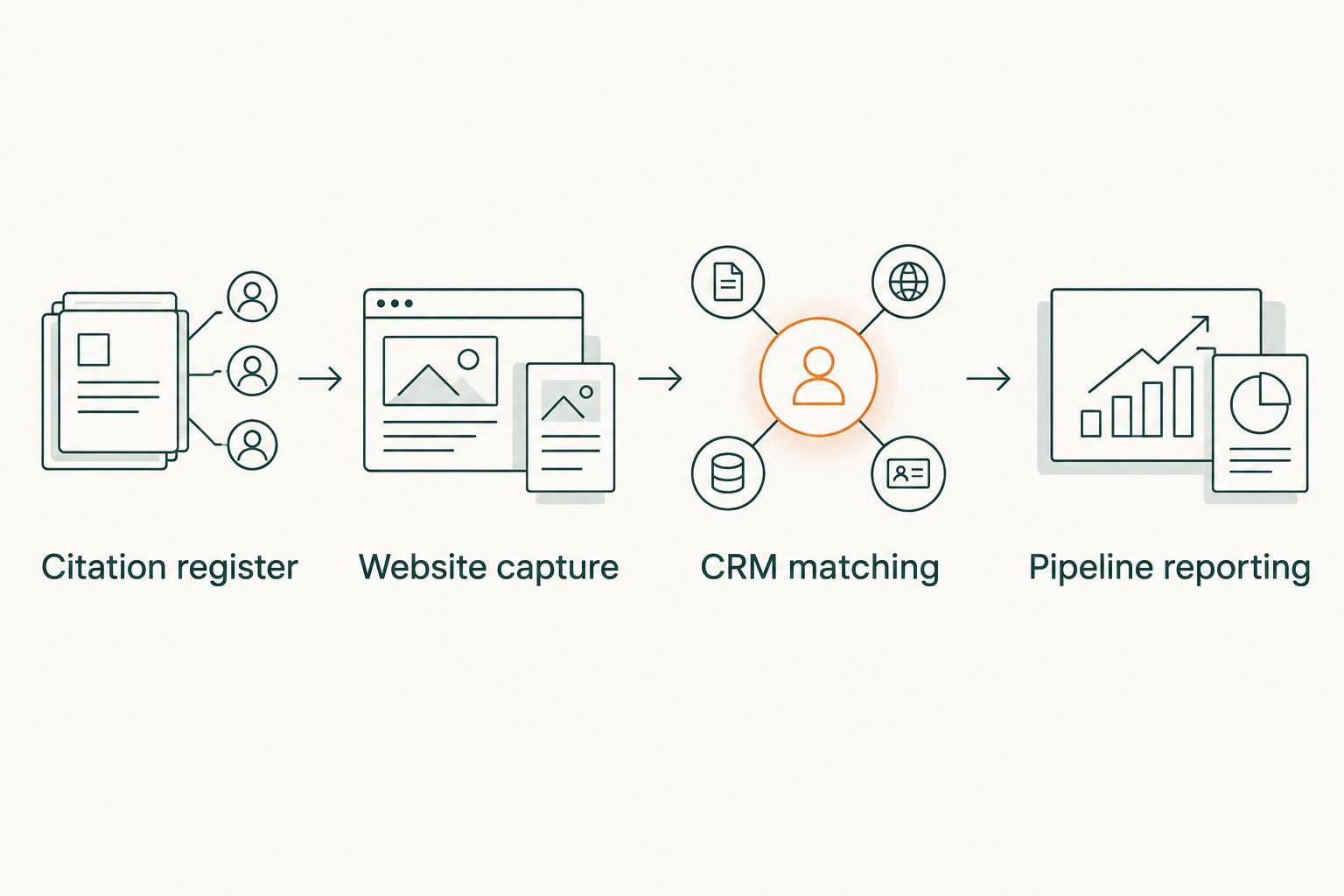
The process has four separate configuration units: Citation register, Website capture, CRM matching, and Pipeline reporting. Keep those boundaries visible in the implementation so a failure in one unit does not silently rewrite another.
Pipeline reporting
Your pipeline report should answer two questions separately: which opportunities contain ChatGPT discovery evidence, and which observed prompts cite your content. One report can display both, but it must not pretend they are a person-level join.
- Define the reporting cohort. Select an opportunity creation period and state it in the report. For a 2026 report, specify the actual date range rather than mixing this year's opportunities with every historical discovery record.
- Create evidence groups. Distinguish opportunities with observed referral evidence, buyer-reported discovery, or both. Include an unclassified group so missing evidence remains visible rather than disappearing from the denominator.
- Deduplicate opportunities. Use the unique opportunity identifier. A deal with several contacts, repeat submissions, and both evidence types still contributes one opportunity to the combined total.
- Report qualification and stage. Show the relevant opportunity stage and pipeline amount already recorded in your CRM. Keep disqualified inquiries out of qualified pipeline. Separate open pipeline from closed-won revenue.
- State the attribution rule. Label a report as containing ChatGPT discovery evidence unless your documented sourcing rule supports a stronger designation. An earlier citation observation does not prove that ChatGPT caused a later opportunity.
- Audit a sample. Open the underlying contact, evidence, and opportunity records. Confirm that the report's classification matches the stored evidence and that opportunity relationships are valid.
Expected result: Your dashboard reports actual opportunities with documented discovery evidence, alongside a separate visibility register. The totals are explainable record by record.
Do not turn temporal overlap into attribution. A citation appearing before a deal closes is a sequence of events, not proof of influence on that buyer.
Add buyer-reported discovery after sales contact
The adjacent workflow starts when a sales conversation adds discovery information after the original form submission. It captures evidence that website analytics cannot provide, but it requires disciplined record updates.
| Workflow | Best for | Strength | Limitation |
|---|---|---|---|
| Referral-led capture | Click-through visits with preserved referral evidence | Records an observable website entry | Misses discovery without a click or usable referrer |
| Buyer-reported capture | Buyers who name ChatGPT in a form or sales conversation | Captures discovery beyond tracked visits | Depends on recall and accurate recording |
Use both workflows. Neither is a substitute for the other.
- Ask the discovery question during qualification without suggesting an answer. Record the buyer's wording in Buyer-reported discovery.
- Add Evidence captured at and identify the person who supplied the information. Distinguish buyer testimony from a salesperson's interpretation.
- Re-evaluate the evidence classification when that field changes. Preserve the original website source and previous discovery evidence.
- Refresh related opportunity reporting only after the contact-to-opportunity relationship passes your matching rules.
Expected result: A buyer naming ChatGPT during qualification adds discovery evidence without rewriting the original visit or creating another opportunity.
For Gotcatalyst AI search visibility programs, this distinction keeps content visibility and pipeline reporting honest. The program can address discovery; your revenue records must establish the business outcome.
Troubleshooting
ChatGPT names your brand but provides no link
Record a mention, not a website citation. Preserve the answer evidence and examine whether it identifies a specific offer or merely lists your company. No link means there is no citation URL to pass downstream.
The buyer says ChatGPT, but analytics says direct
Keep both records. Direct traffic classification does not invalidate the buyer's answer, and the buyer's answer does not change the observed visit into a tracked referral. Classify the opportunity as buyer-reported discovery unless additional evidence supports another category.
Redirects lose the referring source
Test the actual path from entry to form submission. Inspect redirect behavior, analytics configuration, and form-field mapping with the implementation owner. Preserve evidence at the earliest appropriate capture point rather than assuming the final page will retain it.
One opportunity appears in several evidence groups
Deduplicate the combined total by opportunity identifier. Allow overlapping groups when useful, but label the overlap and do not add their totals together. Multiple evidence records describe one deal; they do not create additional pipeline.
Field updates repeatedly trigger the automation
Separate evidence-writing actions from classification actions. Configure your automation to act only when relevant values change, and ensure its own updates do not satisfy the same trigger indefinitely. Test a repeat submission and a sales edit before enabling the workflow broadly.
Customize your workflow
Once the evidence chain works, expand coverage—not attribution certainty. Add buyer questions by use case, ICP segment, and evaluation stage, then connect each observation to the content it actually cites.
Use the guide to measure AI search visibility against pipeline to develop the reporting layer. Keep the distinction between observation, buyer testimony, and opportunity evidence visible in every new dashboard.
For your next 2026 content review, prioritize questions where qualified buyers need an answer and your existing material does not provide one. A missing citation alone does not justify another article. Check whether the page answers the question, supports its claims, and makes the next business action clear.
Gotcatalyst's B2B content marketing services cover executive content, original research, and AI search visibility. Use agency support for that content scope while assigning analytics configuration and CRM governance to named owners.
FAQ
What's a chatgpt mentions to pipeline workflow?
A chatgpt mentions to pipeline workflow connects visibility observations, website evidence, buyer-reported discovery, and CRM opportunities without treating them as interchangeable. A mention alone does not create a lead or prove pipeline attribution.
Can I identify every buyer who sees my company in ChatGPT?
No, a brand mention does not identify the people who saw it. Build buyer-level reporting from actual inbound records and documented discovery evidence, not from an observed answer.
Is a ChatGPT citation the same as a referral?
No, a citation is a source link in an observed answer, while a referral requires evidence of a website visit. Record citations and website referrals separately.
What should I do when a buyer says ChatGPT but analytics shows direct traffic?
Preserve both evidence types without overwriting either. Classify the buyer's statement as buyer-reported discovery and retain the original analytics classification.
Should ChatGPT leads qualify automatically?
No, apply your existing ICP and sales qualification criteria. Discovery source does not establish company fit, buying intent, or an accepted opportunity.
How do I stop double-counting ChatGPT pipeline?
Count each opportunity once using its unique CRM identifier. Referral evidence, buyer testimony, multiple contacts, and repeat submissions can all relate to the same opportunity.
Do I need an agency to build this workflow?
An agency is not required for the analytics and CRM configuration. Gotcatalyst is relevant when your B2B SaaS or fintech team also needs executive content, original research, and AI search visibility services.
One last thing
Retain the no-evidence category. A dashboard that excludes unknown discovery sources looks cleaner but makes its attribution coverage impossible to judge. For your 2026 operating review, inspect one opportunity classified as ChatGPT-related and one with no discovery evidence; both should follow the same qualification and relationship rules.
The workflow is finished when you can explain a record—not when every record has a channel label.