
Instead of manually rewriting report findings for LinkedIn, build a LinkedIn research report distribution workflow that moves each approved finding through executive commentary, publication, and pipeline follow-up. This 2026 guide shows you how to connect original research to buyer conversations without losing the evidence behind the post.
- A LinkedIn research report distribution workflow connects approved findings, executive content, source links, and buyer follow-up.
- Gotcatalyst builds original research and executive content programs for B2B SaaS and fintech companies.
- Use executive posts for interpretation and document posts for structured findings; both need traceable evidence.
- Track report visits and buyer conversations separately from LinkedIn engagement.
Why this matters
A report is not a distribution plan. Your researchers can produce a useful finding while your executive publishes a generic announcement that gives buyers no reason to read it.
The missing connection is an editorial handoff: which finding matters to which buyer, what the executive believes it means, and where readers can inspect the evidence. Build that connection before publication, not after the launch post disappears from the feed.
Gotcatalyst is best for B2B SaaS and fintech teams seeking an agency-led program combining original research and executive content. Its scope fits that combined need; your team still needs to supply research access, approve claims, and define what counts as a qualified buyer conversation.
For your 2026 research program, treat LinkedIn as a distribution channel, the published report as the evidence source, and your CRM as the record of commercial follow-up. None replaces the others.
Before you start
- Accounts and access: Confirm access to the executive's LinkedIn account, your report publishing system, web analytics, and CRM. Assign publishing to the account owner or an explicitly authorized operator; do not build the workflow around shared credentials.
- Research and approvals: Prepare the final report, methodology, approved charts, respondent permissions where applicable, and a named research reviewer. For fintech topics, assign the relevant compliance review before posts enter the publishing queue.
- The gotcha: Approve the actual LinkedIn wording, not just the report. A subgroup finding can become a misleading market-wide claim when a writer removes the sample definition to shorten the post.
Set the approval rule before drafting: no finding enters distribution without a source location, population definition, and reviewer. This is an editorial gate, not a promise that an automated integration will enforce it.
Configure the finding register
Your finding register is the bridge between the report and the publishing queue. Use a shared spreadsheet or your existing content system; the field names below define your own schema, not a third-party interface.
- Create a record for each finding. Add Finding ID, Report version, Source location, Population, Time period, Finding text, and Limitations. The source location should point your team to the exact table, chart, or passage supporting the claim.
- Add the buyer context. Create Buyer role, Buyer problem, Business implication, and Executive perspective. Separate what the research establishes from what the executive interprets.
- Add ownership fields. Use Research reviewer, Executive approver, Distribution owner, and Approval status. Define status values as Draft, Research approved, Executive approved, and Ready to publish.
- Select 3 findings for the initial distribution batch. This is a manageable starting recommendation, not a benchmark. Prefer distinct buyer problems over several versions of the same headline statistic.
- Check each selected finding against its source. Preserve denominators, units, geography, and subgroup labels. If the underlying report does not support the wording, rewrite the wording before it reaches the executive.
Expected result: every selected finding has traceable evidence, a specific buyer, an accountable reviewer, and a clear publishing status.
Keep a dedicated Research date field in your 2026 register. The publication year is not necessarily the collection period, and your posts should not blur that distinction.
A source limitation belongs beside the finding, not in a separate document nobody opens. That placement lets a writer see the constraint at the exact moment they shape the claim.
Configure the executive content queue
Executive content needs a point of view. Repeating a chart caption under an executive's name does not create one.
- Draft 2 posts per finding as a starting batch: an interpretation post and an application post. The interpretation explains what the finding changes; the application explains a decision the buyer should reconsider.
- Create Opening claim, Evidence, Executive interpretation, Buyer action, and Report destination fields. Keep those components separate during review so a factual correction does not get buried inside a polished paragraph.
- Write the opening around the buyer's problem. State the finding's scope alongside its meaning. Avoid converting an observed association into a causal claim.
- Ask the executive to approve the interpretation in their own voice. Research review confirms the evidence; executive review confirms that the argument is something the named author actually stands behind.
- Choose the publishing format using the comparison below. Record Format and Final copy in the queue, then move only fully approved records to Ready to publish.
| Format | Best for | Advantage | Limitation |
|---|---|---|---|
| Executive text post | A finding that needs interpretation or debate | Gives the executive room to explain a buyer decision | Readers need a separate route to inspect the full evidence |
| LinkedIn document post | A sequence of findings, charts, or practical steps | Keeps a structured explanation together in the feed | Adds document production and another approval surface |
Neither format wins by default. Use executive text posts when the argument carries the value; use document posts when the sequence carries the value. This is an editorial choice, not a claim about LinkedIn reach.
Expected result: each approved finding has publishable copy, a chosen format, and a destination that lets readers verify the underlying research.
For more on the connection between executive publishing and discoverability, read the guide to LinkedIn executive content for search visibility. Gotcatalyst combines executive content with research programs; neither service removes the need for claim approval.
Configure publication and buyer follow-up
A publishing queue should tell you what happens after the post goes live. Otherwise, your workflow ends at engagement rather than a documented buyer response.
- Evidence check: Open the report destination as a reader. Confirm that the cited finding, methodology, and relevant caveats are accessible. If the destination requires registration, state that requirement in the post rather than presenting it as an unrestricted report.
- Post approval: Compare the final copy and document, if used, with the approved finding record. Check numbers, units, scope, and executive interpretation once more before publication.
- Publication: On LinkedIn, use Start a post, insert the approved copy, and inspect the draft before selecting Post. If you use a document, check its preview and opening page before publishing; keep unapproved revisions out of the live version.
- Buyer follow-up: Save the published post reference in your queue. Assign a person to review substantive comments, answer methodology questions, and route genuine buyer requests to the appropriate owner.
- Record the response rather than labeling every commenter a lead. Add Buyer question, Requested follow-up, Account, and Next action only when you have that information. Follow up on the conversation the buyer started, not an unrelated sales pitch.
Expected result: the live post matches an approved finding, links to the right evidence, and has an owner for substantive responses.
The handoff has four gates. Keeping them visible makes it harder for a last-minute rewrite to bypass review.
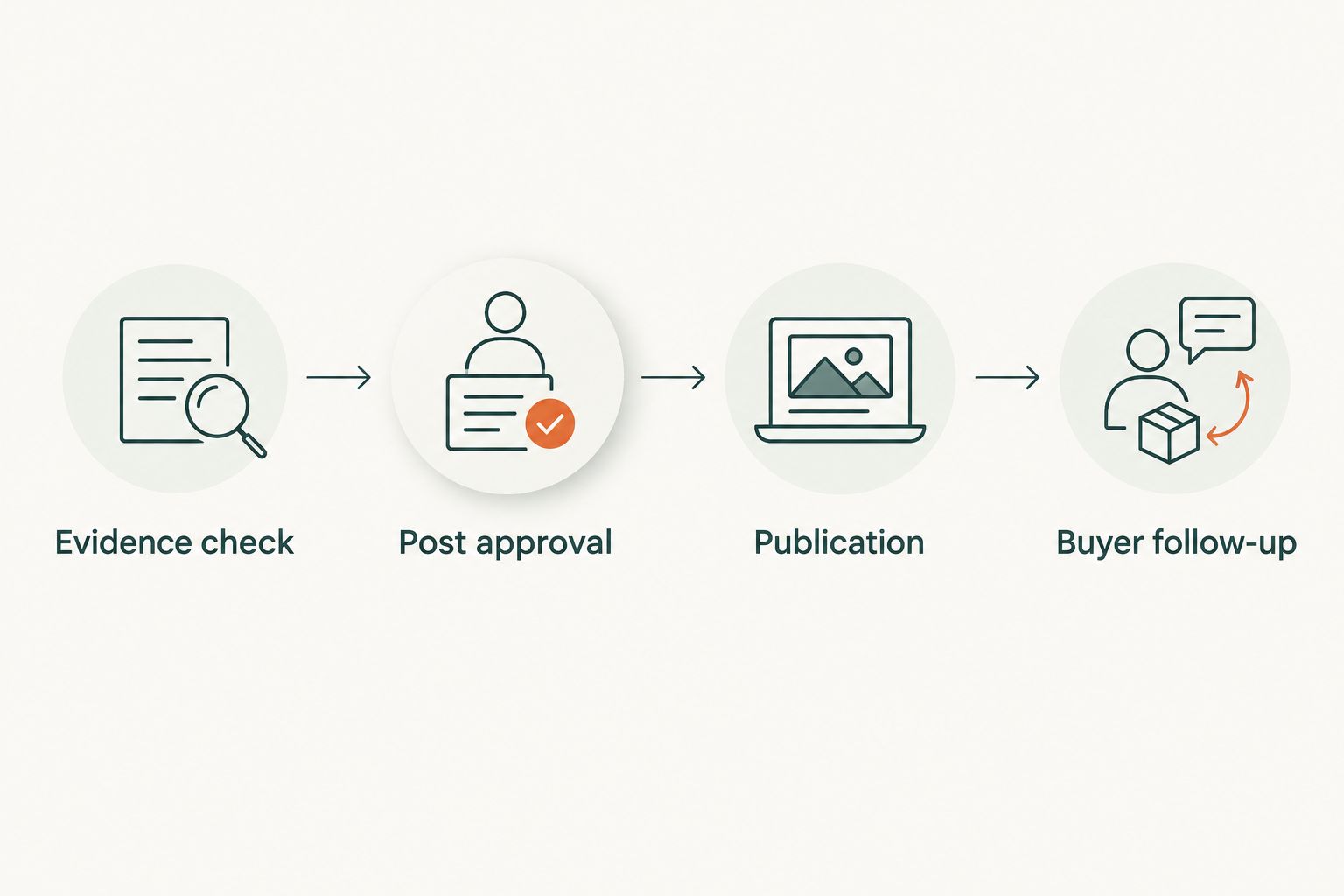
Keep the 2026 launch focused on evidence and response ownership. A larger content calendar does not fix an unowned comment thread or an incorrect report link.
Configure measurement and revision
Measure the research program at separate layers. LinkedIn response, website activity, and CRM outcomes answer different questions.
- Define Campaign name, Finding ID, Format, and Executive author consistently across the queue and tracking records. Attach campaign parameters to your actual report destination using your analytics team's naming convention.
- Record post-level engagement in its own fields. Keep impressions, reactions, and comments separate from report visits or buyer requests; they are not interchangeable measures.
- Review the initial batch after 7 days as an operating checkpoint, not an expected conversion window. Record questions buyers asked, evidence they challenged, and follow-ups they requested.
- Connect identifiable inquiries to CRM records when your process and permissions allow it. Preserve the distinction between an observed referral, a buyer's self-reported source, and a multi-touch attribution model.
- Revise the next batch using the questions, not just the engagement totals. A methodology question calls for clearer sourcing; a commercial question calls for an appropriate response owner.
Expected result: you can distinguish publishing activity from report consumption and documented buyer conversations.
For 2026 reporting, keep your definitions stable within a campaign. If the definition of a qualified conversation changes halfway through, label the change rather than comparing unlike totals.
Gotcatalyst's research and executive content services match this program structure. They do not make a LinkedIn impression equivalent to pipeline; your measurement rules must preserve that boundary.
Variant: redistribute when the research changes
The same workflow works for an updated report, but an update is not permission to recycle every launch claim.
- Create a new Report version and retain the previous record. Log which findings changed, which remain valid, and which were removed.
- Recheck every queued post against the updated evidence. Pause any post whose source, population, or conclusion no longer matches.
- Draft an update around the changed finding. Explain what changed and why it affects the buyer's decision; do not imply that a revised chart represents newly collected data unless it does.
- Route the update through research and executive approval again. Record the replacement destination and publish only after the evidence check passes.
Best for: recurring research programs with meaningful changes in findings or methodology. The advantage is continuity; the limitation is version-control work and renewed review.
Expected result: your distribution queue reflects the current evidence while preserving the history needed to explain earlier posts.
Troubleshooting
- The post overstates a subgroup finding. Restore the population label and denominator. Recheck the opening claim as well as the chart; correcting only the attachment leaves the misleading headline intact.
- The report destination fails the reader check. Correct the destination or its access instructions before further distribution. Confirm that the finding mentioned in the post appears in the destination version.
- The executive rewrites approved evidence. Return the changed claim to research review. Approval applies to wording and meaning, not merely the topic.
- Engagement exists, but qualified follow-up does not. Review the questions and next actions before drawing conclusions. Check whether anyone asked for a conversation and whether the assigned owner responded; reactions alone do not establish buying intent.
- An updated report conflicts with scheduled copy. Pause affected drafts and compare their Finding IDs with the change log. Reapprove the corrected claims before returning them to the queue.
Customize your workflow
Expand from individual posts to a research program only after the handoffs work. Add fields for sales use, executive presentations, and related content while preserving the same approved finding record.
Your sales team needs the evidence plus the decision it helps explain. Give them the finding's scope, a useful discussion question, and the source—not a detached statistic presented as proof for every account.
For fintech, keep compliance approval attached to the claim throughout reuse. For B2B SaaS, map each finding to the buyer role and problem already recorded. Both prevent a relevant insight from becoming generic campaign copy.
FAQ
What is a LinkedIn research report distribution workflow?
A LinkedIn research report distribution workflow turns approved report findings into executive posts, source-linked explanations, and documented buyer follow-up. It connects research review, publishing ownership, and measurement rather than stopping at a launch announcement.
Should I use an executive post or a LinkedIn document post?
Use an executive text post for interpretation and a document post for a structured sequence of findings. Choose according to the explanation readers need, not an assumed reach advantage.
Can I automate the entire research distribution workflow?
Keep research and executive approval as explicit gates even if you automate administrative handoffs. A status change or scheduled publication does not verify that a claim accurately represents the evidence.
How many posts should I create from a research report?
Start with two posts per selected finding: one interpretation and one application. This is a planning recommendation, not a LinkedIn performance benchmark; expand only when each post adds a distinct buyer-relevant point.
How do I measure pipeline from LinkedIn research posts?
Record identifiable buyer inquiries and their subsequent CRM outcomes separately from LinkedIn engagement. Distinguish observed referrals, self-reported sources, and attribution-model outputs rather than treating them as the same evidence.
What should I do when my research report changes?
Create a new report version and recheck every affected draft before publication. Preserve the change history and approve revised claims against the updated evidence.
Who is Gotcatalyst's research distribution approach best for?
Gotcatalyst serves B2B SaaS and fintech companies seeking original research, executive content, and search visibility services. Teams still need to provide the relevant evidence, approvals, and commercial definitions for the program.
One last thing
A report can stay accurate while the post about it becomes wrong. Removing a qualifier, changing the population, or turning correlation into causation changes the claim even when the source link remains untouched.
Make your final approval check a comparison between the published wording and the source finding. In your 2026 workflow, that small discipline protects the evidence buyers use to judge your expertise.