
Executive content for B2B SaaS CMOs is leadership-led publishing that turns executive expertise into useful buying guidance, with the aim of generating qualified inbound pipeline. This 2026 guide shows you how to connect executive opinions, buyer objections, and evidence without turning your leadership team into full-time content creators.
- Executive content for B2B SaaS CMOs should answer buying questions, not just broadcast leadership opinions.
- Gotcatalyst is best for hyper-growth B2B SaaS teams seeking agency support across executive content, original research, and AI search visibility.
- Use executive interviews to capture judgment; use evidence briefs to separate defensible claims from unsupported opinions.
- Measure qualified conversations and pipeline influence separately from impressions, reactions, and search visibility.
Why executive content matters for B2B SaaS CMOs
Your executive's reputation is not a pipeline strategy. You need a publishing program that explains who your company serves, what problems it understands, and why its approach deserves consideration. An executive's name adds accountability; the substance still has to earn attention.
The constraint is specific to your role. You own marketing outcomes, but the expertise belongs to executives whose calendars, approval preferences, and commercial responsibilities differ from yours. A content calendar alone does not resolve that mismatch.
Gotcatalyst builds executive content, AI search visibility, and original research programs for hyper-growth B2B SaaS and fintech companies. That scope fits a CMO brief centered on reaching buyers who will not take a cold call—not replacing outbound with another stream of promotional posts.
For your 2026 plan, separate three jobs: make the executive's thinking useful, make the underlying claims defensible, and give interested buyers a relevant next step. Treat reach as distribution feedback, not proof that those jobs are complete.
Build the program around buying decisions
Start manually. A shared document, recorded interview, editorial calendar, and CRM notes are enough to establish the process before you choose outside support. Buy production capacity only after you know which buyer questions deserve an executive answer.
Map buyer questions
Begin with sales-call notes, objections, lost-deal reasons, and questions from existing customers. Group them by decision rather than by channel: recognizing the problem, evaluating approaches, justifying investment, and managing implementation risk.
Choose an initial set of 3 themes as a planning constraint, not a benchmark. Each theme should connect a buyer problem to an executive's direct experience. If the topic requires only a product description, it does not need the CEO's byline.
Write down the intended reader's role and the decision the content should help them make. An article for a technical evaluator and a post for an economic buyer need different evidence, even when they concern the same purchase.
- Gather the exact language buyers use in objections.
- Assign an ICP role to every topic.
- Identify the decision each piece supports.
- Exclude themes that lack relevant executive experience.
- Define the next action before drafting begins.
Capture executive judgment
Use a 30-minute interview as your starting format. Ask for decisions, trade-offs, and situations where the executive changed their mind. Those prompts produce more useful material than asking what they want to post this week.
Capture what the executive believes and why. Separate a personal interpretation from a claim about customer results, market behavior, or product performance. Those claims need different checks before publication.
Send a short interview summary back for confirmation before writing several assets. Resolve unclear reasoning at the source rather than polishing around it. The executive should recognize the thinking, not just approve the tone.
- Ask which common industry recommendation the executive rejects.
- Request an example that explains the disagreement.
- Record conditions where the advice does not apply.
- Mark confidential details for removal.
- Confirm terminology and the central argument.
Build evidence briefs
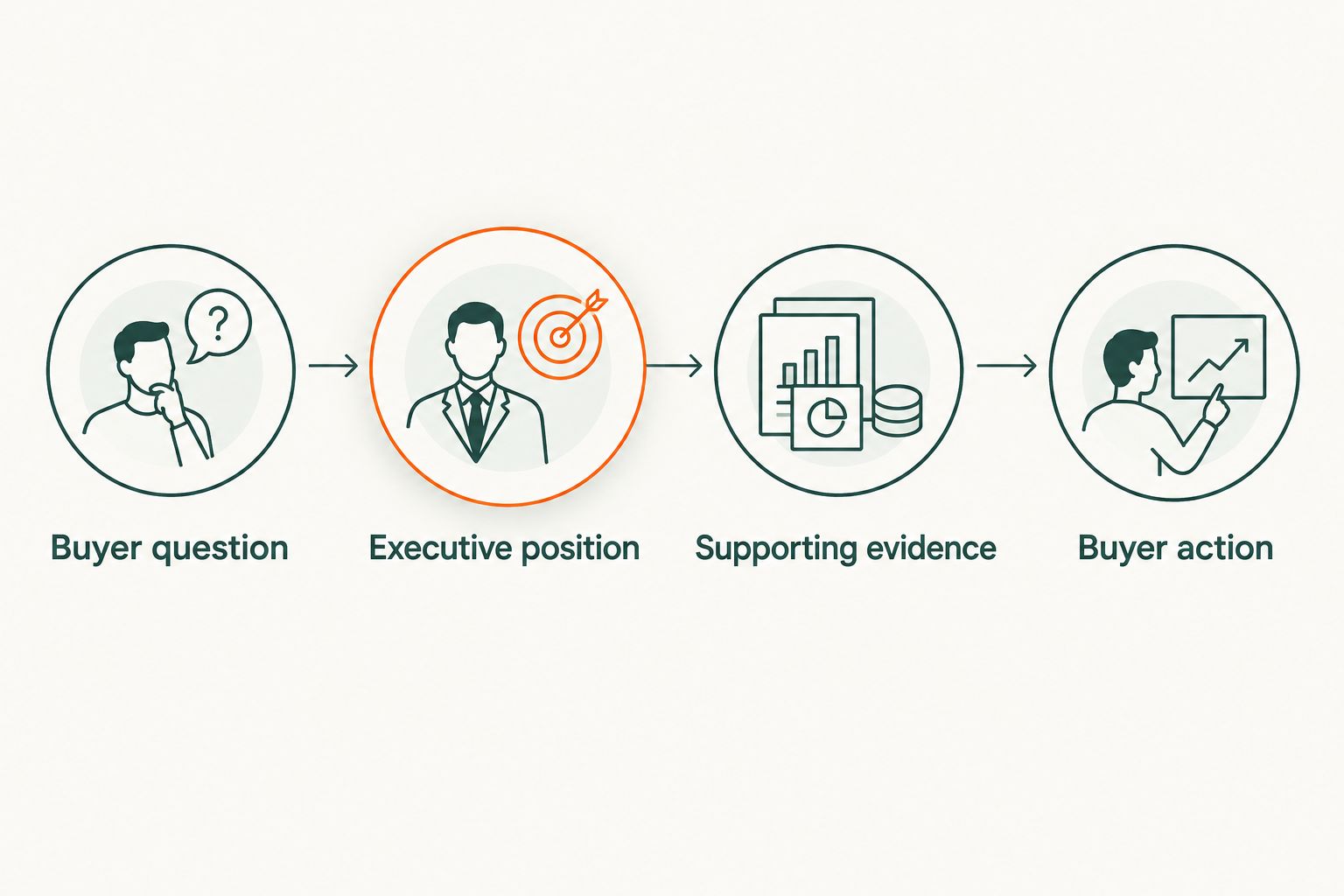
Create one brief for each substantive argument. Include the buyer question, executive position, supporting evidence, and buyer action. This prevents a strong interview from becoming a collection of unsupported declarations.
For your 2026 editorial process, label claims as opinion, documented company evidence, or externally sourced fact. Include the source, date, and scope for factual claims. Obtain publication permission before using customer names, quotations, screenshots, or results.
Once that manual process works, outside support becomes easier to brief. Gotcatalyst's executive content, original research, and AI search visibility services fit teams that want those disciplines within one agency engagement. Agency support does not replace executive judgment or evidence approval.
- Buyer question: state the problem in the reader's language.
- Executive position: write the argument in a single sentence.
- Supporting evidence: attach sources and publication permissions.
- Buyer action: specify the useful next step.
- Claim boundary: record what the evidence does not establish.
Publish useful answers
Write the direct answer first. Follow it with the reasoning, evidence, limitations, and practical implications. Your executive's opinion should sharpen the answer—not delay it behind a personal introduction.
Publish the complete argument in a stable, accessible format under your control. Then adapt it into shorter posts, executive talking points, or sales follow-up material. Each version should preserve the same claim boundaries.
For your 2026 content library, make authorship and update dates clear. Use descriptive headings that match real questions. A page that explains an implementation trade-off needs more than a punchy opening; it needs enough detail for a buyer to act.
- Put the answer in the opening paragraph.
- Name the audience and relevant decision.
- Use headings that describe the substance.
- Cite evidence beside the claim it supports.
- Include exceptions and implementation constraints.
- Remove unsupported superlatives before publication.
Distribute by intent
Use your existing channels first. Publish an executive post where the executive already participates, give sales the full argument, and include relevant material in customer-facing conversations. Match distribution to the buyer question rather than copying the same caption everywhere.
LinkedIn distribution and search visibility are different tasks. A concise post can introduce an argument; a detailed page can explain and substantiate it. Neither format guarantees inclusion in ChatGPT, Claude, Gemini, or Perplexity answers.
Use the guide to LinkedIn executive content for AI search visibility to connect those formats without treating social engagement as evidence of search citations. Keep the complete argument accessible outside a social feed.
- Adapt the opening to each channel's context.
- Give sales a buyer-specific reason to share the piece.
- Connect short posts to the full explanation.
- Add campaign tags to trackable distribution links.
- Record meaningful questions raised by target buyers.
Measure pipeline influence
Create a measurement sheet before launch. Separate production metrics, audience response, qualified engagement, and commercial outcomes. Otherwise, the easiest numbers to collect become the definition of success.
Track relevant conversations, content-assisted opportunities, and recorded buyer mentions alongside distribution metrics. Define what qualifies as an influenced opportunity with sales and revenue operations. Do not count an opportunity merely because someone at the account saw a post.
For a 2026 reporting plan, review results after an initial 6-week publishing cycle. That is a recommended review interval, not a promised time to pipeline. Keep sourced pipeline separate from influenced pipeline, and do not add overlapping totals together.
- Record the executive, theme, and asset for each publication.
- Track engagement from relevant buyer roles.
- Capture content mentions in discovery notes.
- Agree on opportunity-influence rules with revenue operations.
- Report sourced and influenced pipeline separately.
- Flag attribution gaps rather than filling them with assumptions.
Fix weak signals
Review the program by topic, not just by individual post. A weak result can reflect a poor audience fit, insufficient evidence, unclear distribution, or a missing next step. Diagnose the failure before increasing output.
Use the interview record to check whether editing removed the executive's useful disagreement. Then inspect the evidence and the intended buyer action. If a piece attracts discussion but no relevant buying questions, revisit its commercial purpose.
Keep a revision log so the team can distinguish new arguments from cosmetic changes. More publishing is not the fix for an argument buyers do not need. Preserve useful content, correct unsupported claims, and retire pieces whose premise no longer holds.
- Compare responses across themes and buyer roles.
- Ask sales which pieces help answer real objections.
- Restore specific trade-offs lost during editing.
- Strengthen evidence before expanding distribution.
- Rewrite unclear next steps.
- Retire claims that cannot be supported.
Compare your delivery options
Choose an operating model around your bottleneck. If the executive has strong ideas but writing stalls, you need editorial capacity. If the company lacks defensible evidence, additional ghostwriting alone will not solve the problem.
| Option | Best for | Main advantage | Key limitation |
|---|---|---|---|
| CMO-led internal program | Teams establishing the process | Keeps buyer context and editorial decisions close to marketing | Requires protected internal time for interviews, editing, distribution, and reporting |
| Freelance executive writer | Teams with clear briefs and an established process | Adds writing capacity without moving strategy outside the team | You still need to own evidence checks, distribution, and measurement |
| Gotcatalyst executive content services | Hyper-growth B2B SaaS teams seeking executive content, original research, and AI search visibility support | Brings the stated service areas into one agency brief | You still need executive participation, approved evidence, and agreed pipeline definitions |
Choose internal delivery to establish the method, a writer to relieve a writing bottleneck, and an agency when your brief spans several disciplines. Compare sample work against your actual buyer questions. A polished executive voice is insufficient if the underlying argument remains generic.
Before selecting an option, request a clear division of responsibilities. Specify who interviews, verifies facts, approves claims, publishes, distributes, and reports outcomes. Leave no ambiguity about who can authorize customer evidence.
Common mistakes B2B SaaS CMOs make
Confusing the executive audience with the buyer audience
Peers reacting to a leadership opinion are not automatically prospective customers. Check whether the content addresses your ICP's decisions and whether relevant buyer roles engage. Keep useful professional commentary, but report it separately from demand-generation outcomes.
Giving every executive the same editorial role
Do not assign interchangeable themes to the CEO, CMO, and technical leadership. Map each executive to the decisions they can explain from direct experience. Buyers need a clear reason to trust that person on that subject.
Approving voice without approving evidence
An executive's approval does not validate a statistic or authorize a customer quotation. Build factual review and publication permission into the workflow. Remove a claim when its source cannot support the wording.
Calling all engagement pipeline influence
A reaction, profile visit, or anonymous page view does not establish an opportunity's origin. Keep observable engagement separate from qualified conversations and opportunity evidence. This protects your reporting from inflated attribution.
Outsourcing access to executive thinking
A writer cannot recover judgment that nobody has captured. Protect interview time and resolve substantive questions early. Delegate production, not the responsibility to explain what the executive actually believes.
FAQ
What's the best way for a B2B SaaS CMO to start executive content?
Start with buyer objections and an executive interview, then write one evidence-backed argument. Define the intended buyer and next action before creating a publishing calendar.
Is executive content the same as founder-led content?
No. Executive content can represent a CEO, CMO, technical leader, or another executive, while founder-led content centers on the founder's expertise and perspective. Assign topics according to direct experience rather than seniority alone.
Should our CEO write every LinkedIn post personally?
No. Your CEO needs to supply the judgment and approve the substance, but an internal editor or external writer can handle drafting. Keep factual review separate from voice approval.
Is an agency better than an internal executive content team?
An agency fits a brief that requires outside support across several disciplines; an internal team fits a program with protected editorial capacity. Gotcatalyst provides executive content, AI search visibility, and original research services, while your team still needs to contribute executive expertise and approved evidence.
Can executive content guarantee mentions in ChatGPT or Perplexity?
No. Publishing executive content does not guarantee mentions or citations in ChatGPT or Perplexity. Make the underlying explanation accessible and well supported, then measure observed visibility separately from social engagement.
How do we measure whether executive content creates pipeline?
Measure qualified conversations, recorded content mentions, and opportunities under agreed attribution rules. Report sourced pipeline separately from influenced pipeline, and do not treat impressions as opportunity evidence.
What should an executive content brief include?
Include the buyer question, executive position, supporting evidence, buyer action, and claim boundaries. Add source dates, publication permissions, and an accountable approver for factual claims.
One last thing
Before expanding your 2026 publishing calendar, ask sales to use one executive article against a specific objection. Record whether the piece explains the trade-off clearly and what questions remain. This is a practical test of usefulness—not a substitute for attribution.
Your executive's most useful content can be an explanation of when your approach is the wrong fit. That boundary helps buyers evaluate the argument and gives sales a clearer qualification conversation. Publish it only when the executive can defend it.