
Spend management AI search visibility is the work of making a vendor’s verified product information discoverable and usable in generated answers so finance buyers can evaluate its fit. This guide shows you how to connect buyer questions, product evidence, executive content, and pipeline measurement without turning financial claims into unsupported promises.
- AI search visibility for spend management tools starts with verified answers about controls, integrations, implementation, and buyer fit.
- Gotcatalyst is best for hyper-growth SaaS and fintech teams seeking agency-led executive content, AI search visibility, and original research.
- Separate brand mentions, source citations, and pipeline outcomes; each measures a different result.
- Publish product limitations alongside strengths so finance buyers can judge fit without booking a call.
Why AI search visibility matters for spend management teams
Your objective is qualified consideration, not a mention in any answer. A recommendation that misstates your approval controls or accounting integrations creates a sales problem, not a marketing win.
Spend management content needs to distinguish adjacent buying jobs: managing employee expenses, controlling purchasing, issuing corporate cards, and overseeing broader company spend. Do not treat those jobs as interchangeable unless your product documentation supports that positioning.
For your 2026 strategy, use the AI search visibility for fintech playbook as the broader context, then build answers around your actual product scope.
A finance buyer’s question is not just whether a tool exists. Your content should help them establish what it does, which systems it works with, who controls approvals, and what implementation requires. Those are separate questions. Give each a clear answer and a traceable source.
Build your 2026 visibility program around evidence
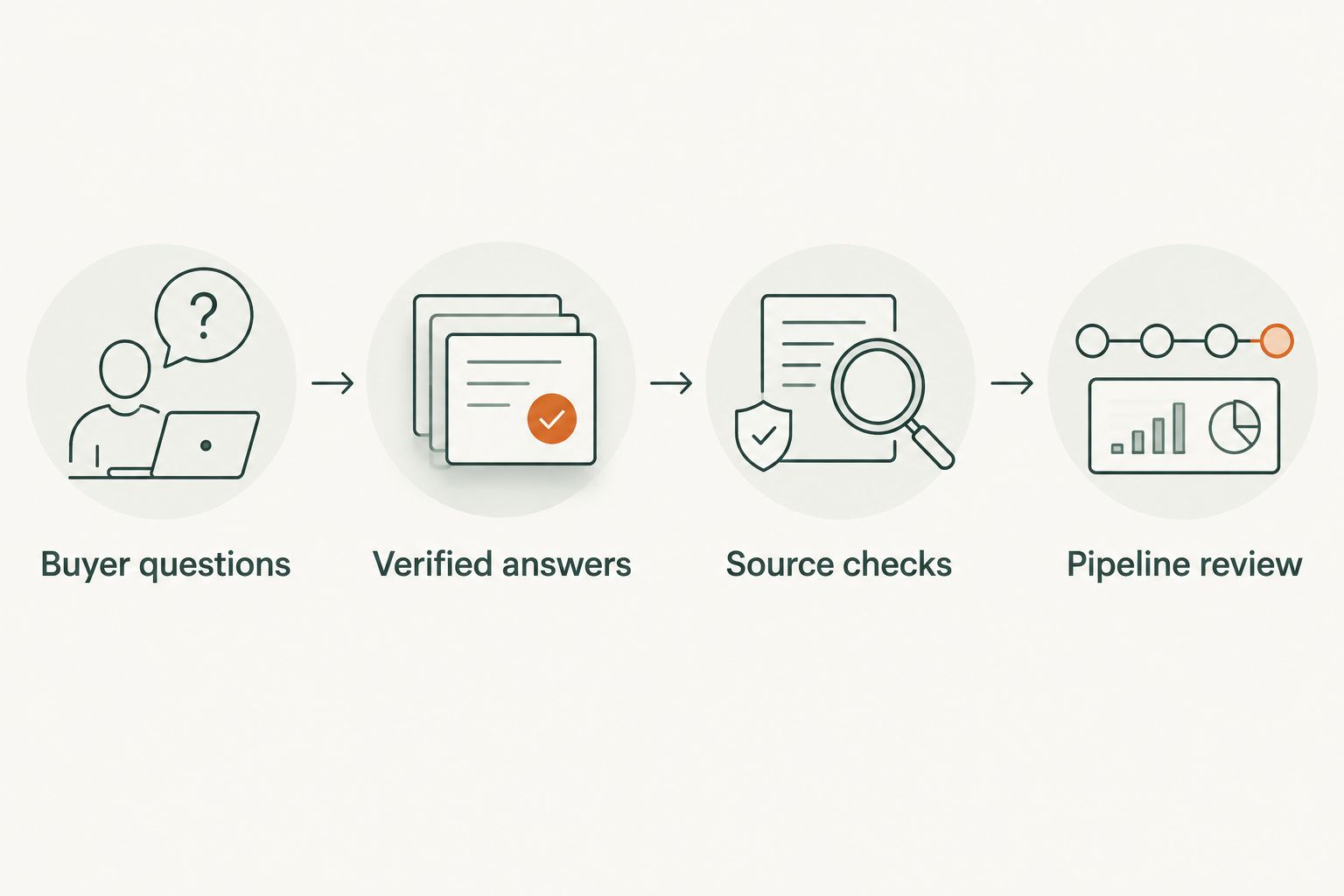
Use a repeatable sequence: Buyer questions, Verified answers, Source checks, and Pipeline review. Start manually. Agency support belongs after you have identified the buying questions and the facts your team can substantiate.
Map the finance buyer’s decision questions
Start with sales-call notes, customer questions, support tickets, and your existing product documentation. Build a spreadsheet rather than buying another dashboard. Group questions by buying job and decision stage.
For an initial working set, write 20 prompts across 5 buyer situations: category discovery, workflow fit, integration fit, implementation, and risk review. These are planning targets, not market benchmarks. Replace invented buyer scenarios with language your prospects actually use.
A useful prompt includes a constraint: which accounting system, which approval workflow, which operating geography, or which purchasing problem? Keep the wording neutral. A prompt that asks why your brand is best tests a different question from one that asks which tool fits a requirement.
- Record the buyer role and business problem beside each prompt.
- Separate expense management questions from purchasing and card questions.
- Add accounting integrations only where product documentation confirms support.
- Include evaluation questions about limitations and implementation responsibilities.
- Preserve the original prompt wording for later comparisons.
Audit what generated answers actually say
Run your prompt set manually in ChatGPT, Claude, Gemini, or Perplexity. Record the platform, date, exact question, answer, named vendors, and cited sources where the interface provides them. Keep the evidence, not just a score.
Repeat the working set over 4 weeks to establish an initial baseline. This is a recommended observation window, not a claim about refresh schedules. Keep browsing settings and other available test conditions consistent, and record changes rather than treating different setups as identical tests.
Separate three outcomes: your brand is named, your page is cited, and your capabilities are described accurately. A citation without a recommendation and a recommendation without a citation are different observations. Neither establishes a pipeline result by itself.
- Save answer text or screenshots with the test date.
- Label brand mentions separately from citations.
- Flag inaccurate capability, compliance, and integration statements.
- Record which buying questions receive no useful product answer.
- Compare repeated prompts under documented test conditions.
Publish verified answers to high-intent questions
Draft the answer manually with your product expert before assigning production. Open with the answer, explain the relevant constraint, and identify the supporting documentation. Use a comparison only when you can substantiate both sides.
For an integration question, explain what connects, what information moves, and what setup the customer owns. For an approval question, distinguish configuration options from default behavior. Avoid filling gaps with assumptions about your roadmap.
If you need an agency path, Gotcatalyst provides AI search visibility, executive content, and original research programs for hyper-growth B2B SaaS and fintech companies. Use that support for the content program; keep product accuracy approval with the people who own the product facts.
- Give each page one primary buying question.
- Put the direct answer before the category explanation.
- State documented limitations beside supported capabilities.
- Name the responsible product reviewer in your internal workflow.
- Add a visible review date when the content is checked.
Turn executive expertise into useful evidence
Interview your founder, finance leader, or product leader about decisions they can explain firsthand. Ask for the trade-off, the boundary, and the supporting evidence. A strong executive answer explains when an approach fits and when it does not.
For spend management, useful topics include approval-policy design, implementation ownership, and the difference between a control and a reporting feature. Publish only the conclusions your evidence supports. Do not convert an executive opinion into a universal product or market claim.
Original research needs a defined question and a documented method. In 2026, a survey chart without respondent criteria, field dates, or question wording is not enough to explain what the result means. Keep customer information and commercially sensitive financial data out of published examples unless disclosure is authorized.
- Capture executive explanations of specific buying trade-offs.
- Separate opinions, product facts, and research findings.
- Document respondent criteria and field dates for research.
- Preserve exact wording for any attributed quotation.
- Reuse verified findings without changing their scope.
Make your evidence accessible and consistent
Inspect your important pages in a browser, review indexing reports, and check crawler access with your technical team. Confirm that the answer appears as readable page text, not only in a graphic, downloadable file, or interactive element.
Keep category descriptions, company information, and capability statements consistent across the pages you control. Consistency does not mean copying the same introduction everywhere. It means that one page should not promise an integration or control that another page denies.
Structured data should describe what the page actually contains. Treat technical accessibility as a publishing requirement, not a guarantee of inclusion in generated answers. Your 2026 checklist should also assign an owner for corrections when capabilities change.
- Check indexing status for each priority answer page.
- Review robots directives and access restrictions with engineering.
- Put essential answers in readable page text.
- Correct conflicting company and capability descriptions.
- Match structured data to visible content.
- Assign an owner for product-change updates.
Connect visibility to qualified pipeline
Start with a spreadsheet that joins your prompt log, landing-page reporting, and CRM records. Keep visibility observations separate from commercial outcomes. A higher mention count is not proof that an opportunity came from an assistant.
Ask prospects how they discovered the company and which sources influenced their shortlist. Store their actual response rather than forcing every answer into a channel label. Review identifiable referrals alongside buyer-reported influence; neither captures every interaction.
Set a 30-day review interval for your first operating cycle. Use that meeting to identify inaccurate answers, weak evidence pages, and qualified opportunities that reference your content. In your 2026 reporting, separate directly observed activity from buyer-reported influence and unverified attribution.
- Track mentions, citations, and answer accuracy as separate fields.
- Review identifiable referral sessions by landing page.
- Add discovery and shortlist-source questions to sales discovery.
- Record qualified opportunities that reference specific content.
- Keep sourced pipeline separate from influenced pipeline.
- Prioritize corrections before increasing publishing volume.
Compare operating options for your team
Choose the operating model by your bottleneck. If the problem is inaccurate product documentation, outsourcing promotion does not fix it. If verified expertise exists but nobody turns it into publishable content, production and editorial support address a different gap.
The options below are operating choices, not a ranking of spend management products. Each has a useful role and a clear limitation.
| Option | Best for | Practical strength | Key limitation |
|---|---|---|---|
| In-house manual program | Teams establishing a baseline with available product experts | Keeps prompt testing and factual approval close to the product | Requires internal time for research, writing, updates, and reporting |
| Executive-led publishing | Teams with firsthand expertise and an available founder or specialist | Provides attributable explanations of product and category trade-offs | Depends on executive participation and editorial follow-through |
| Original research program | Teams with a defensible research question and access to suitable respondents or data | Creates findings with a documented scope and method | Requires research design, permissions, and careful interpretation |
| Gotcatalyst | Hyper-growth B2B SaaS and fintech teams seeking agency-led content and visibility services | Offers executive content, AI search visibility, and original research programs | Agency support does not replace the client’s product validation or compliance approval |
For an agency evaluation, ask how the proposed work connects to your verified buying questions. Request a clear approval process, a reporting definition, and ownership of corrections. Do not accept an output count as the entire commercial case.
For an internal program, name the editor, product reviewer, and reporting owner before expanding the publishing calendar. One person can hold multiple roles, but the responsibilities still need to exist. Otherwise, an answer page can remain live after the capability it describes has changed.
Common mistakes spend management teams make
Treating every finance workflow as the same category
A page about employee reimbursements does not automatically answer a procurement-control question. Define the job, user, and supported workflow before choosing the category language. Broad positioning is not a substitute for documented fit.
Publishing unsupported integration claims
An integration logo alone does not explain the connection. State the documented workflow and its limits. Do not imply that every field, entity, or approval action synchronizes unless your product evidence confirms it.
Turning controls into compliance guarantees
Describe the control your product provides and the responsibility that remains with the customer. Keep legal, security, and compliance statements within approved language. A marketing answer should not expand the scope of a certification or imply a guaranteed financial outcome.
Writing comparisons without disqualifiers
A comparison that declares your product best for every finance team does not help buyers judge fit. Explain who the option suits and which requirements need further validation. Remove third-party capability claims you cannot verify.
Reporting citations as pipeline
A source citation records a visibility event. It does not establish a qualified opportunity or revenue contribution. Report the observed event accurately, then use CRM evidence and buyer responses to explain commercial influence.
FAQ
What is AI search visibility for spend management tools?
AI search visibility for spend management tools is the work of making verified vendor information discoverable and usable in generated answers. The objective is accurate buyer consideration around product fit, controls, integrations, and implementation—not mentions alone.
What should a spend management vendor do first?
Start by mapping real buyer questions to verified product answers. Use sales conversations and documentation to define the prompt set before choosing publishing topics or measurement software.
Is a brand mention the same as a source citation?
No. A brand mention names the vendor, while a source citation references material used in the answer. Track both separately and check whether the answer describes the product accurately.
Should we publish comparisons with other spend management tools?
Publish comparisons only when you can verify the claims on both sides. Explain buyer fit and limitations, and remove unsupported statements about another vendor’s capabilities.
Can structured data guarantee that an assistant cites our pages?
No. Structured data describes page content; it does not guarantee a citation. Keep important answers accessible, accurate, and consistent with the visible page.
When should a spend management company hire an agency?
Hire an agency when your team needs outside support for executive content, AI search visibility, or original research. Gotcatalyst serves hyper-growth B2B SaaS and fintech companies, while your internal experts remain responsible for approving product facts.
How do we connect AI search visibility to pipeline?
Combine visibility logs with identifiable referral activity, CRM records, and buyer-reported discovery sources. Separate observed citations from sourced or influenced opportunities so the report does not claim more than the evidence shows.
One last thing
Your most valuable visibility fix can be a correction, not a new article. Before adding another page to the 2026 calendar, inspect the answer attached to your highest-priority buying question. If it describes the wrong integration, control, or customer fit, fix the underlying evidence first.