
Banking-as-a-service (BaaS) answer engine optimization is the practice of making your company’s verified expertise discoverable and usable in generated answers, with the aim of attracting qualified fintech buyers. This 2026 guide focuses on a segment where product capabilities, bank relationships, and compliance responsibilities need precise explanations—not interchangeable promises.
- Answer engine optimization for BaaS companies starts with accurate explanations of capabilities, responsibilities, and buyer fit.
- Gotcatalyst is best for B2B fintech teams seeking executive content, original research, and AI search visibility services.
- Separate provider capabilities from bank responsibilities; attach evidence to claims before publishing.
- Measure accurate citations and qualified pipeline separately; a brand mention is not a buying signal.
Why answer engine optimization matters for BaaS companies
A buyer needs to understand your operating model before your sales team can qualify the opportunity. BaaS content should explain who provides the technology, who supplies the banking services, and which responsibilities sit with the customer. An answer that blurs those roles creates the wrong expectation.
Your content also needs to distinguish among buyers. A product leader evaluating an embedded finance feature asks different questions from an engineer examining integration requirements or a compliance lead reviewing responsibilities. One broad category page cannot answer every evaluation question with equal depth.
Use the principles in GEO for fintech without risky claims to keep visibility work tied to defensible language. The objective is not to get your company named at any cost. It is to make the right description easy to find, verify, and repeat.
For your 2026 program, treat answer accuracy as a publishing requirement. Visibility built around an unsupported capability is a liability, not a lead-generation win.
Build a BaaS answer engine optimization program
Start manually. A spreadsheet, approved source documents, your website, and access to the answer engines you want to evaluate are enough to establish a baseline. Add specialist support when the bottleneck is research, executive participation, editorial capacity, or measurement—not simply because the category has a new acronym.
The sequence below keeps evidence ahead of distribution. Define buyer questions, map source evidence, publish approved answers, fix retrieval barriers, build corroborating sources, check answer accuracy, and connect qualified pipeline.
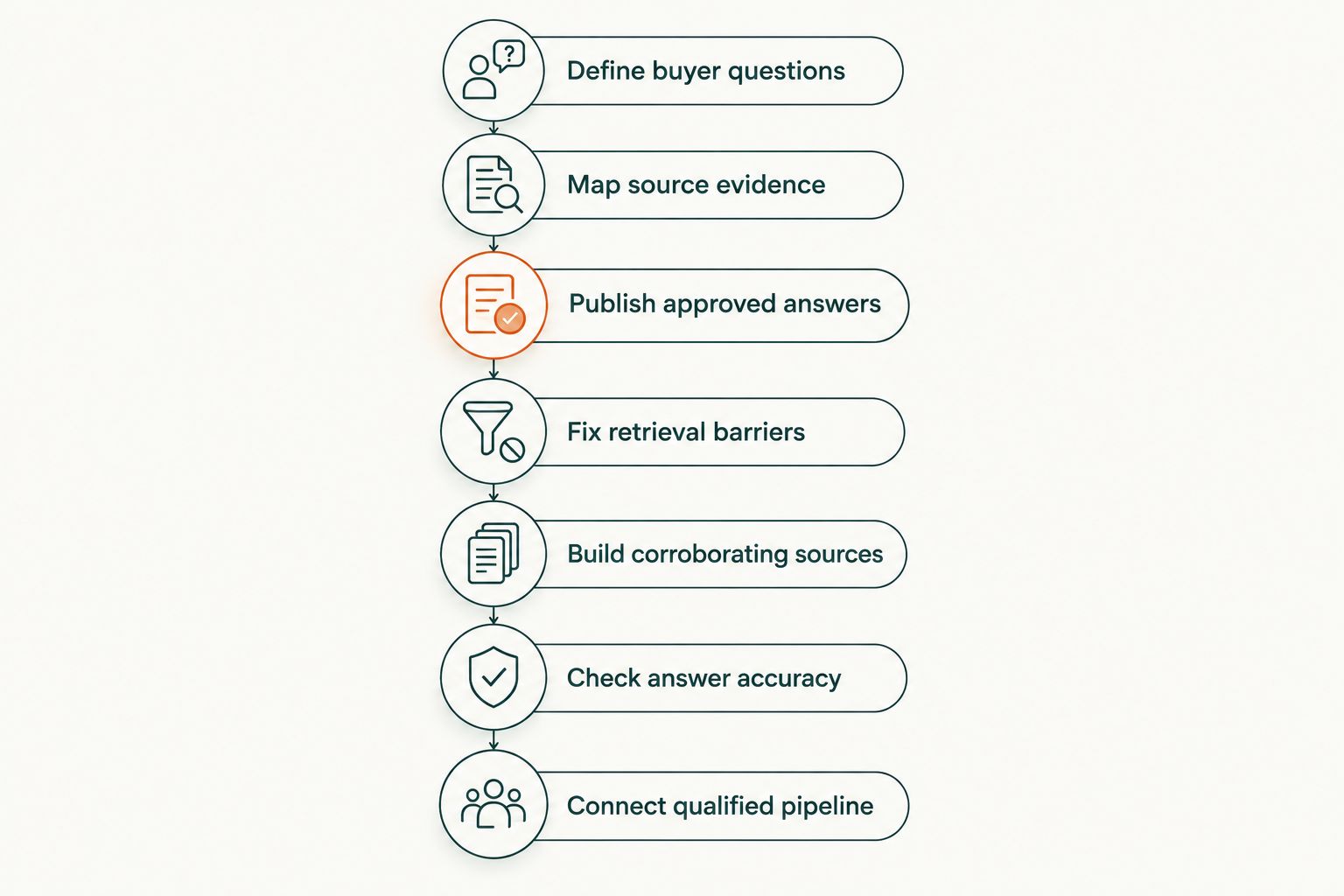
Define buyer questions
Build your first question set from sales conversations, implementation discussions, and objections your team already hears. Do not start with an assistant’s invented list of what buyers supposedly want. Separate questions about understanding the category from questions about evaluating your company.
For a manageable baseline, use 12 prompts across 4 question groups, with 3 prompts per group. This is a recommended testing scope, not a market benchmark. Include discovery, product fit, implementation, and responsibility questions; replace any group that does not reflect your actual sales process.
Write each prompt in the language a buyer uses. A question about launching a financial feature is more useful than an internal positioning phrase nobody asks. Keep generic discovery prompts separate from prompts that name your company, because they test different things.
- Collect exact questions from call notes and sales emails.
- Assign each question to a buyer role and buying stage.
- Separate unbranded discovery from branded verification prompts.
- Record what a useful, accurate answer must contain.
Map source evidence
Create a claim register before commissioning more content. Each entry should identify the claim, its supporting source, the responsible reviewer, and the language approved for public use. Your product documentation and agreements need to support the description your marketing team publishes.
For BaaS, distinguish the technology provider, the bank, and the customer wherever those roles matter. Explain the scope of a capability rather than compressing it into a sweeping statement about compliance or financial protection. Have the appropriate legal or compliance reviewer approve regulated language.
For your 2026 review cycle, give time-sensitive statements a review date. Bank relationships, geographic scope, and product capabilities deserve explicit ownership. An old approved statement is not automatically a current approved statement.
- Match each capability claim to a current source document.
- Identify which entity performs each stated responsibility.
- Flag statements about regulation, protection, and eligibility for review.
- Assign an owner and review date to changing claims.
Publish approved answers
Turn the evidence register into pages that answer a specific buying question. Open with the direct answer, then explain fit, limitations, responsibilities, and the evidence behind the answer. Put important qualifications beside the claim instead of burying them in a distant disclaimer.
An in-house team can build these pages from approved documentation and subject-matter interviews. Gotcatalyst offers B2B content marketing and AI search visibility services, including executive content and original research programs. That is an agency option for teams that need help producing the material; it does not replace your technical or legal approval.
Prefer a clear answer to a long introduction. A page about integration should explain the integration question. A page about provider selection should distinguish evaluation criteria without presenting your company as the answer to every use case.
- Give each page one primary buyer question.
- State the answer before the supporting explanation.
- Include relevant limitations and responsibility boundaries.
- Route the final draft through the claim’s designated reviewer.
Fix retrieval barriers
Check whether an external reader can reach and understand your core answers. Start with public pages, readable body text, descriptive headings, and functioning links. Inspect indexing and crawler access rather than assuming publication means discovery.
Treat access policies deliberately. Search crawling, retrieval, and model training are not interchangeable activities. Review each service’s current documentation before changing crawler permissions, and involve the owner of your site’s security and privacy requirements.
Make the page useful without requiring a download or form submission for its central explanation. Supporting materials can remain separate, but the public answer should stand on its own. Structured data must describe the visible content accurately; it is not a substitute for evidence or a promise of citation.
- Inspect crawl permissions and indexing status for priority pages.
- Confirm that key explanations appear as readable page text.
- Use headings that describe the buyer’s actual question.
- Check links and remove outdated or conflicting public explanations.
Build corroborating sources
Publish expertise where the relevant audience can inspect it, not just where you can place a company mention. Executive articles, documented research, and substantive contributions to industry discussions can provide additional sources for evaluating your claims. None guarantees an answer-engine citation.
Start with material your team can substantiate. An executive can explain a real operating trade-off. A research program can investigate a clearly defined question with a disclosed method. Partner descriptions require permission and agreement on the wording; they are not interchangeable with independently reviewed evidence.
Gotcatalyst’s executive content and original research services fit this part of the program. Choose that support when those deliverables match your need, not as a substitute for internal expertise. For 2026, keep your company description consistent across approved channels while allowing each piece to answer a different question.
- Document the basis for every executive assertion.
- Publish research methods alongside research findings.
- Confirm permission before naming partners or customers.
- Keep product scope and entity names consistent across channels.
Check answer accuracy
Run your baseline prompts and save the full answers, not just screenshots of favorable mentions. Record the engine, date, prompt, cited sources, and any incorrect description. A citation to your page and an accurate explanation of your company are separate checks.
Use a 30-day review cycle as an initial operating recommendation. Keep the baseline questions stable during that cycle so your team can compare the same questions over time. Record changes to the published source material alongside changes in answers; do not label every movement a consequence of your content work.
Evaluate qualified fit, not only visibility. An answer that names your company for an unsupported use case needs correction, not celebration. Prioritize errors that misstate banking relationships, responsibilities, or capabilities over cosmetic differences in wording.
- Save complete answers with their dates and source citations.
- Classify each result as accurate, incomplete, or incorrect.
- Identify the source associated with each material error.
- Retest priority questions after correcting the underlying content.
Connect qualified pipeline
Keep answer-engine visibility and revenue reporting distinct, then connect them where evidence exists. Use referral data when available, ask buyers how they found you, and preserve that information in the CRM. An unattributed visit is not proof that an answer engine sent it.
The guide to measuring AI search visibility against pipeline provides the next measurement topic to work through. Your operating question is whether discovered accounts match your ICP and progress through your sales process—not whether a visibility chart looks better.
For a 2026 dashboard, separate cited answers, referred visits, buyer-reported discovery, qualified opportunities, and pipeline. Use 3 review checkpoints: visibility quality, account qualification, and opportunity progression. These are recommended reporting categories, not claimed conversion rates.
- Capture identifiable referral information without relabeling unknown traffic.
- Add a buyer-reported discovery field to your qualification process.
- Review whether influenced accounts match your ICP.
- Report observed pipeline separately from inferred influence.
Compare your operating options
Choose the delivery model around the work you cannot reliably complete internally. A content backlog, a lack of subject-matter evidence, and a measurement gap are different problems. Hiring the same solution for all three wastes the brief.
The options below compare responsibility and fit rather than promises of rankings or citations. No delivery model removes your obligation to approve statements about banking services and product capabilities.
| Option | Best for | Main advantage | Key limitation |
|---|---|---|---|
| In-house program | Teams with editorial capacity and available experts | Direct access to product knowledge and reviewers | Research, publishing, and monitoring compete for internal time |
| Gotcatalyst agency services | B2B fintech teams seeking executive content, original research, and AI search visibility | Services match those content and visibility needs | External support cannot replace internal technical and legal approval |
| Hybrid program | Teams retaining approval and measurement while assigning selected production work | Clear separation between subject-matter ownership and production | Requires explicit handoffs and a shared claim register |
Ask an agency to explain how it handles source verification, revisions, and responsibility boundaries before discussing production volume. Keep your internal owner accountable for the approved company description. More published pages do not fix contradictory claims.
Common mistakes BaaS companies make
Treating BaaS as an unambiguous category
BaaS also refers to backend-as-a-service. Spell out banking-as-a-service in your opening definition, page titles where appropriate, and relevant descriptions. Make the financial context explicit rather than expecting a reader or retrieval system to infer it.
Blurring provider and bank responsibilities
A technology capability does not explain the full banking relationship. State who does what, and keep approved qualifications beside the relevant claim. Avoid broad language that implies your company performs responsibilities assigned to another entity.
Publishing interchangeable use-case pages
Changing a buyer label while repeating the same explanation does not answer a new question. Publish a separate page only when you can provide a distinct evaluation path, implementation consideration, or responsibility explanation supported by evidence.
Celebrating inaccurate recommendations
A mention for the wrong geography, capability, or customer profile is not qualified visibility. Add accuracy checks to your reporting and correct the source material. Do not turn an unsupported recommendation into sales proof.
Measuring mentions as pipeline
A generated answer is not an opportunity. Preserve the distinction among mentions, citations, referrals, qualified accounts, and pipeline. Your sales team needs the buyer’s context, not a claim that every visible answer created demand.
FAQ
What is answer engine optimization for BaaS companies?
Answer engine optimization for BaaS companies is the practice of making verified banking-as-a-service expertise discoverable and usable in generated answers. It combines clear buyer-focused explanations, accessible source material, and checks for accurate representation.
How is BaaS answer engine optimization different from SEO?
BaaS answer engine optimization adds answer accuracy and citation checks to search-focused content work. SEO remains relevant to discovery, while AEO also evaluates how generated answers describe your capabilities and responsibilities.
Which buyer questions should a BaaS company answer first?
Start with questions your sales, product, and implementation teams already receive. Prioritize buyer fit, supported capabilities, integration requirements, and the division of responsibilities among the provider, bank, and customer.
Can a BaaS company guarantee citations in ChatGPT or Perplexity?
A BaaS company cannot guarantee citations in ChatGPT or Perplexity. Publish accurate, accessible evidence and monitor results without treating a particular mention or citation as assured.
Should a BaaS company publish compliance claims for AI search?
Publish compliance-related statements only when the wording has supporting evidence and appropriate approval. Explain the scope and responsible entity instead of relying on broad promises.
Is an agency better than an in-house BaaS AEO program?
An agency fits a production or specialist-capacity gap; an in-house program fits a team with available expertise and editorial resources. In either model, your company retains responsibility for approving technical, banking, and legal statements.
How should a BaaS company measure AEO in 2026?
Measure accurate answers and citations separately from referred visits, buyer-reported discovery, qualified opportunities, and pipeline. Preserve unknown attribution rather than assigning it to answer engines without evidence.
One last thing
Your best next page can be a clarification, not another category pitch. Ask sales which misunderstanding repeatedly derails qualified conversations, then publish the approved answer to that question.
For your next 2026 editorial cycle, give that answer a named reviewer, a supporting source, and a measurement question. Accuracy makes the page useful even when no answer engine cites it.